Short film guide
How to Make a Short Film With AI: Plan It in Three Scenes
How to make a short film with AI on your iPhone: plan three scenes, make each as its own short vidmi video from the same photo, then join them in iMovie.
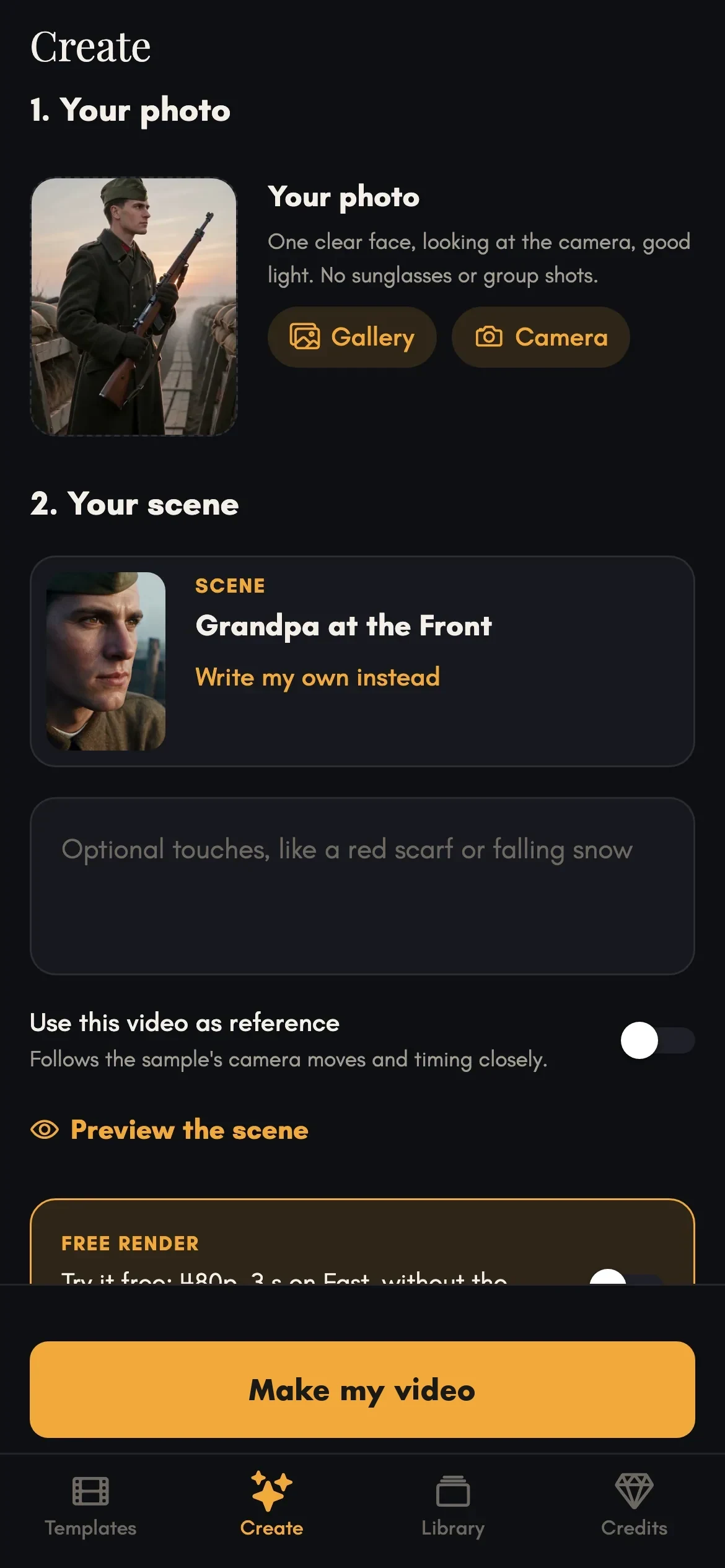
To make a short film with vidmi, plan three scenes. Each scene is its own video of 3 to 10 seconds, made from the same photo, and you join them afterward in iMovie, outside vidmi. A story, in other words, is something you plan and assemble, one short video at a time. For the wider picture, see the AI short film generator.
Think in scenes, not seconds
Every vidmi video is one scene: one place, one moment, one face. A story is what happens when you put scenes in an order that means something.
So before you open vidmi, open Notes and plan.
Write the beat sheet
A beat is one thing that happens. Give each beat one line, and give your story three of them.
- The setup. Where are we, and who is this?
- The turn. Something gets harder, bigger, or stranger.
- The payoff. The moment the whole thing was building to.
Here is one you could make tonight, starring yourself:
- Before dawn in a mountain cabin, lacing up boots by a window full of snow.
- Climbing the last ridge in hard wind, head down, one step at a time.
- Standing on the summit as the sun breaks through the clouds.
Three lines, and you already know how it ends. That is the point. When the ending is clear, every scene before it has a job.
Once three feels easy, stretch to four or five. Add a quiet moment before the payoff, or a small surprise after it.
Turn each beat into a sentence
Now each line becomes what you type into “Describe your scene in your own words”. One scene per video, one sentence per scene.
- “me lacing up hiking boots in a log cabin before dawn, snow falling outside the window”
- “me climbing a rocky ridge in strong wind, red jacket flapping, clouds below”
- “me standing on a mountain summit with arms open as golden sunlight breaks through the clouds”
Notice the red jacket. Put the same clothing, the same color, and the same time of day in every sentence that needs it. Those small repeats help three videos feel like one story, though each video is made fresh and the match is never exact.
If a beat matches one of the scenes in the Templates tab, use it. A story about a grandfather could open in Field at Dusk and turn in Grandpa at the Front. Add your continuity details in the “Customise” box, like “a gray wool cap”.
Not sure a sentence says what you mean? Tap “Preview the scene”. It shows, in words, what the film will show, before you spend anything. For more on phrasing, read how to write a scene.
Keep the settings the same
A story works best when the three scenes look like they belong together. Using the same photo and the same settings helps, but it does not promise that the clips match. Decide these once, then leave them alone:
- Photo. The same face photo for every scene. Pick a clear one once, as in how to choose the best photo, and reuse it.
- Model. Fast, Quality, or Max. Mixing them can change the level of detail between cuts.
- Resolution. Keep it the same, so no scene looks softer than the next.
- Shape. All 9:16 for Stories and Reels, or all 16:9 for a TV.
- Sound. Choose one for the whole story. If you plan to lay your own music over the top, “Silent” leaves room for it.
Length is the one setting worth varying. A quick 3 s turn between a 5 s setup and a 7 s or 10 s payoff gives the story rhythm. Let the ending breathe.
Film in order, then check
Make the setup first and watch it before you go on. If something in it works, like a color or an angle, repeat it in the next sentences.
You can have up to three videos in progress at once, so once the first scene works, start the other two together. If you allowed notifications, you get one as each is ready.
If a scene doesn’t land, make that one again. Don’t redo the whole story for one weak beat.
Put it together
Save each finished scene with “Save to Photos”. Then line them up in a video editor, setup to payoff. Our guide to stitching clips in iMovie walks through it step by step.
Watch the whole thing once with the sound off. If the story still reads, the beats are doing their job.
Where to go next
For the craft behind the three beats, read the three-act short. And if one story leaves you wanting a next chapter, see how to make a series, using the same photo and settings each time. New to vidmi? Start with how to turn a photo into a video.
Questions
How many scenes should my first story have?
Three. A beginning, a turn, and an ending. It is enough to feel like a story and short enough to finish in one sitting.
Can I mix templates and scenes I write myself?
Yes. Each scene is its own video, so one can start from a template and the next from your own sentence. Keep the photo and the format the same and they are more likely to sit together.
Can vidmi join the scenes into one film?
No. Each scene comes out as its own short video. Save them to Photos and put them in order in a video editor such as iMovie.