One-sentence scenes
The Art of the One-Sentence Scene
A one-sentence story packs a whole arc into a line. A one-sentence scene picks a single moment, which is what a five-second film can hold. Here is how to write one.
A screenplay scene opens with a heading line that fits on a napkin. Inside or outside. Where. What time of day. A jazz bar, night. A fjord, dawn. Three facts, and the whole crew knows where to stand.
That habit is older than any of us, and it exists for a reason. A scene is one place and one moment. If it takes a paragraph to say where you are, you are probably describing two scenes.
A one-sentence story, a beginning, a turn and an ending in a line, is a fine thing to write. A short film is the other kind: one sentence, one moment. It shows a person doing something in a place. It will not carry words on screen or chosen dialogue, so the picture has to do the talking.
Five seconds holds one moment
A vidmi film runs 3, 5, 7, or 10 seconds. Count five seconds out loud. That is one look across a room. One step onto grey dust. One hand lifting a cup.
It is not a story with a beginning, a twist, and an ending. It is the single frame you would put on the poster, given a few seconds to breathe.
So the question is never “how much can I fit in?” It is “which moment do I want?”
Who, where, doing what
A common screenwriting habit is one scene, one job. A one-sentence scene does that job with three parts.
- Who. You, or someone you love. “Me.” “My grandpa.” “My mom at twenty-five.”
- Where. A place you can picture with your eyes closed. A smoky bar. A wooden street at dusk. The Moon.
- Doing what. One action. Singing. Standing watch. Walking.
The examples in the app follow exactly this shape: “me singing jazz in a smoky bar” and “me walking on the Moon.” Short, and you already see the film.
Specific beats clever
Here is where most first tries go sideways. People reach for big words.
“My grandmother in an epic, emotional, cinematic journey through time” sounds impressive and shows nothing. There is no place in it. No light. Nothing for her hands to do.
Now try this: “my grandmother reading a letter at a Paris café table in the rain.”
No adjectives about feeling at all. But you can see the wet street, the cup, the paper, her face tilted down. The feeling arrives on its own, because the picture is doing the work. Writers call this showing instead of telling.
A quick test: could a stranger draw your sentence? “Epic” can’t be drawn. “Rain on a café table” can.
One detail is a spotlight
Good films are remembered for small things. A coat. A lantern. Dust hanging in a doorway.
One detail in a sentence works like a spotlight. It tells everyone what matters. Ten details work like turning on every light in the house. Nothing stands out.
So choose one. “My dad on a Viking longship, fur cloak, mist on the water” has a single texture to hold on to. Add the weather or add the wardrobe. You rarely need a list of both.
Arrive late, leave early
Another piece of familiar screenwriting advice: come into the scene as late as you can and get out as soon as you can. Skip the walk to the door. Open on the door already swinging.
For a one-sentence scene, that means dropping the setup. You don’t need “I travel to the Old West and then I arrive in a town and then I stand in the street.” You need “me standing on a dusty Western main street at noon.” Start in the middle. The middle is the film.
Try it
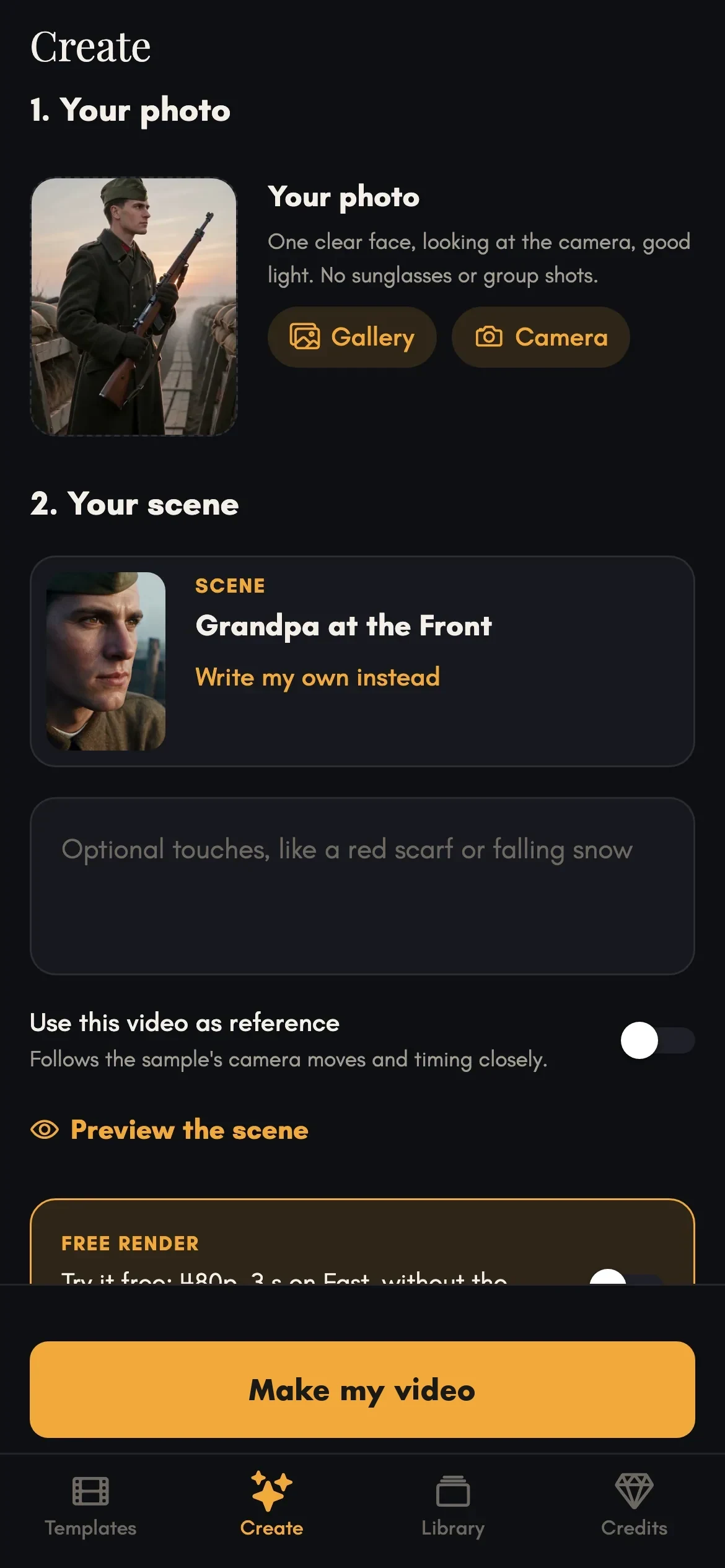
Open the Create tab, add a face photo, and write one sentence under “Describe your scene in your own words.” If you want a starting point, borrow one of these and swap in your own person:
- “me playing piano in an empty concert hall, one lamp on”
- “my grandpa on the deck of a fishing boat at sunrise”
- “my sister in a 1920s library, pulling a book from a high shelf”
Then tap “Preview the scene.” It tells you, in words, what the film will show before you spend anything. If the preview is not the moment you had in mind, change one word and look again. Usually the fix is a clearer place or a simpler action, not a longer sentence.
Once the sentence is right, the rest is choosing your options and letting vidmi direct.
Where to go next
This is the why. For the how, with patterns you can fill in line by line, read how to write a scene. For sentences ready to borrow, browse the ideas. If the app does not accept a scene, why wasn’t my scene accepted covers your next step. A prompt is just the sentence you type, and writing your own scene shows the box it goes in. And if you want to think about framing and mood as well as words, the directing tips pick up where this leaves off. More essays live on the blog.
Questions
How long can my scene description be?
The box on the Create tab takes anything from 3 to 500 characters. One clear sentence fits with plenty of room to spare.
Can I see what I will get before I make the video?
Yes. Tap "Preview the scene" under your description and vidmi shows you, in words, what the film will show before you spend anything.
What if I don't want to write at all?
Pick a ready-made scene on the Templates tab. You can still add a detail in the "Customise" box, like a red scarf or falling snow.